If there’s one thing 2025 has made clear, it’s this: industries and large facilities can’t afford to take fire readiness lightly anymore. Construction sites are getting larger, industrial operations are running hotter, and insurers are demanding higher standards across the board. In this new landscape, having an NFPA-compliant fire water tank strategy isn’t a “nice to have.” It’s the backbone of operational safety.
For facilities that want to stay compliant, protected, and fully functional, the question isn’t whether they need a reliable emergency water supply. It’s whether their current system is actually enough for what’s coming.
NFPA Requirements in 2026: What’s Changing and Why It Matters
The National Fire Protection Association (NFPA) has always set the benchmark for how a facility should prepare for fire emergencies. But as industries grow more complex and remote projects become the norm, the expectations are evolving.
In 2026, NFPA guidelines place stronger emphasis on:
- Proven capacity for emergency water supply
- Material durability and corrosion resistance
- Reliable pressure and flow delivery
- Accessibility for fire crews
- Long-term maintenance and testing routines
This means every facility, especially those in construction, manufacturing, processing, and warehousing, must evaluate whether their current water storage tanks meet modern safety demands.
An NFPA Water Tank isn’t just about meeting a line in the code. It influences insurance premiums, project approvals, and the ability to operate without interruption. Facilities that fall short aren’t just risking fines; they’re risking lives, equipment, and multimillion-dollar assets.
Why Facilities Can’t Rely on Municipal Water Alone
One of the biggest misconceptions in facility management is the idea that municipal water is enough. On paper, it might seem reliable. But in practice, especially in industrial zones or large construction sites, it’s unpredictable at best.
1. Pressure Drops at Critical Times
Fire emergencies demand extremely high flow rates. Municipal systems can’t guarantee that, especially when:
- Several facilities draw from the same line
- Pressure drops during peak usage hours
- The infrastructure is aging or overloaded
2. Remote and developing locations have zero guarantees
Construction sites often operate far from established networks. Industrial parks located in evolving areas can also face unpredictable water availability.
3. Some facilities require more water than the grid can deliver
High-risk operations like welding shops, material yards, warehouses, and manufacturing lines need emergency reserves far beyond municipal capacity.
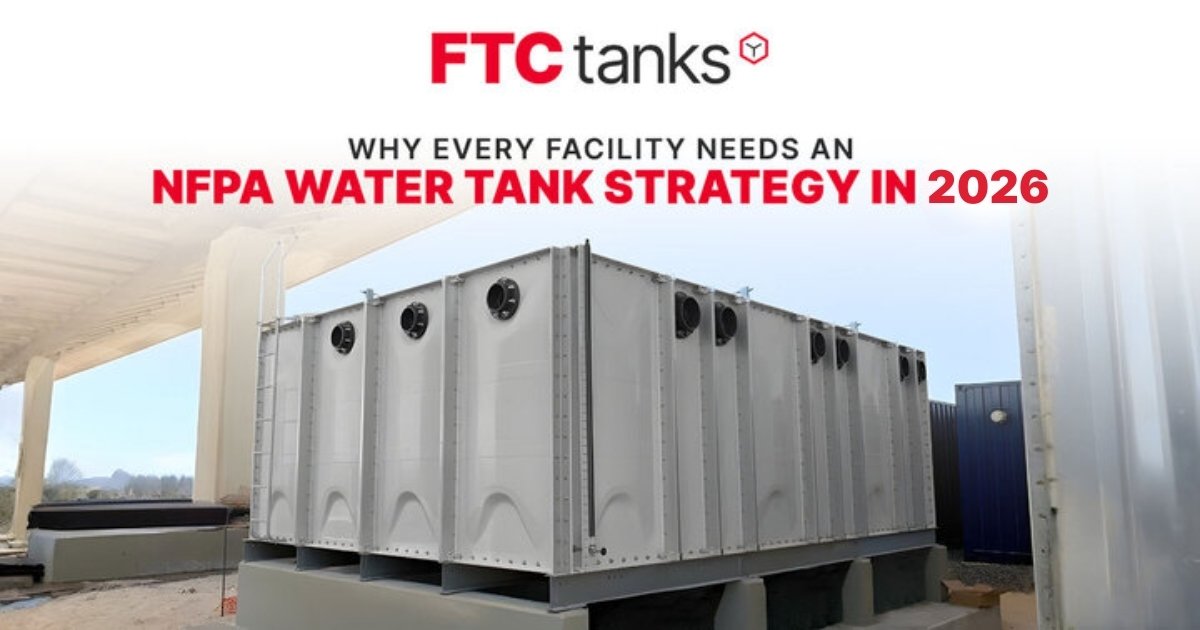
A dedicated on-site cistern, water cistern, or properly designed fire water tank solves these issues by ensuring constant access to controlled, reliable water storage, day or night, emergency or not.
The Rise of FRP Tanks: A Smarter Choice for Modern Facilities
While steel and concrete tanks have served industries for decades, the shift toward FRP tanks is growing fast, and for good reason.
FRP (Fiberglass Reinforced Plastic) water tanks are engineered to overcome the typical weaknesses of traditional materials. They don’t corrode, they aren’t affected by chemicals or salty environments, and they handle extreme weather conditions without losing structural strength.
Why FRP Outperforms Steel & Concrete:
- No rusting, scaling, or internal corrosion
- High strength-to-weight ratio
- Lower lifetime maintenance costs
- Faster installation
- Suitable for above-ground, underground, and modular applications
Many facilities also rely on NSF-certified water tanks for dual-purpose use: fire protection plus domestic or operational water. FRP systems make this possible without compromising safety or compliance.
For temporary or evolving construction sites, FRP offers another major advantage: mobility. Tanks can be relocated, expanded, or integrated into new layouts as the project grows.
Designing a Fire Water Tank Strategy That Fits Your Facility
A one-size-fits-all approach doesn’t work when it comes to fire readiness. Each facility, each site, and each industry brings its own risks and water-demand profile.
Considerations for Large Industrial Facilities:
- High-volume fire-flow requirements
- Continuous operations that can’t shut down
- Exposure to fuels, chemicals, machinery, or high heat
- Need for large-capacity water storage tanks that maintain quality and flow consistency
Considerations for Construction Sites:
- Temporary but critical fire protection
- Need for lightweight, relocatable systems
- Rapid installation without disrupting ongoing work
- Above-ground FRP tanks often preferred for quick deployment
Considerations for Commercial Complexes:
- Insurance compliance
- Building-code approvals
- Integration with pump rooms, sprinklers, and hydrant networks
Whether it’s a 10,000-gallon cistern or a multi-tank FRP system supplying a full industrial park, the design must match the actual risk, and not the minimum requirement.
Common Gaps That Cause NFPA Violations (and How to Avoid Them)
Facilities don’t fail NFPA inspections because they ignore safety. They fail because they underestimate the details. Here are the most common issues inspectors find:
1. Undersized water tanks
This happens when facilities expand operations but keep old storage capacities.
2. Inaccessible tanks
Firefighters must be able to reach and draw from the tank without delay.
3. Lack of inspections and maintenance
Even an NFPA certified tank can fail operational testing if not maintained.
Having a proper NFPA Water Tank plan means addressing these risks from day one, not after an emergency exposes them.
Future-Proofing Your Facility for 2026–2030
Fire risks are evolving across every industrial environment. Higher temperatures, heavier equipment, denser storage, and longer project timelines all contribute to greater exposure.
This is why facilities are moving toward:
- Larger, scalable storage systems
- Corrosion-proof FRP water tank designs
- Multi-tank configurations for redundancy
- Modular builds that can expand with project phases
A smart fire water tank strategy doesn’t just tick a compliance box; it protects your future operations, your workforce, and your capital.
Why Partnering With Experts Matters
Designing an NFPA-compliant system isn’t something facility teams should handle alone. From tank sizing to flow testing, the details matter.
We at FTC Tanks support industries, construction companies, and large facilities with NFPA-ready FRP water tanks, fire water tank solutions, and NSF certified water tanks engineered for long-term reliability. With proper guidance, your facility can stay compliant, resilient, and ready for whatever 2026 brings.
Final Takeaway: 2026 Will Reward the Prepared
Fire readiness isn’t something facilities can treat as a checkbox anymore; it’s become a fundamental part of running a safe, responsible operation. Whether you’re pouring concrete on a fast-moving construction site, managing a busy manufacturing floor, or overseeing a sprawling commercial complex, having a reliable, NFPA-approved fire water tank strategy gives you a safety net you can count on when it matters most.As we move into 2026 and the standards continue to rise, the facilities that take preparedness seriously won’t just stay compliant they’ll lead the way. And if you want a system built to last, built to perform, and built for real-world conditions, FTC Tanks can help you put the right fire water tank plan in place from day one. Contact us today!